Mines India | educational guide

Mines Game: Rules and How It Works

Understand the board, safe tiles, mines and probability in a clear guide for India.

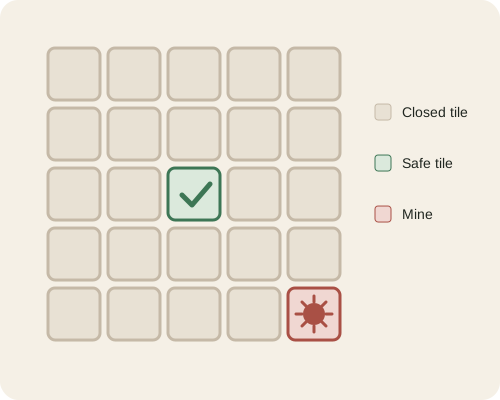
Illustrative 5 by 5 Mines board showing a safe tile, a closed tile and a mine

What is the Mines game?

Mines is a board-based game model in which a grid contains hidden safe tiles and mines. A round starts with every tile closed. The aim is to reveal tiles without uncovering a mine.

On a typical 5x5 board, the chosen mine count determines how many of the 25 tiles are safe. Each safe reveal changes the number of unopened tiles, so the mathematical chance for the next selection can be described clearly.

The location of mines is random in this illustrative model. A previous safe tile does not create a guaranteed pattern for the next one. See the Mines probability calculator for a clear view of the remaining-tile formula.

The basic model

How a Mines round works

Use these four steps to understand the structure of a 5x5 Mines board.

  1. 1

    Choose a mine count

    The board has 25 tiles. A higher mine count leaves fewer safe tiles.

  2. 2

    View the closed board

    At the beginning, each tile looks the same and no location is known.

  3. 3

    Reveal tiles

    A safe tile remains part of the revealed sequence; a mine ends the illustrative round.

  4. 4

    Stop or continue

    The model can describe the odds of another selection, not its outcome.

Mines Game Rules

Board layout

This guide uses a 5x5 board with 25 total positions. Other products may use different layouts, so their settings can produce different numbers. For the fixed-board model used here, open the probability calculator.

Mine count

The mine count is the number of hidden mine positions. If there are 5 mines, 20 of the 25 tiles are safe at the start.

Safe tile

A safe tile is any tile without a mine. After it is revealed, there is one fewer unopened tile and one fewer safe tile remaining.

Mine

In the standard Mines model, revealing a mine ends that round. It is a random outcome, not a signal about earlier selections.

Ending a round

Some interfaces describe a choice to stop after safe reveals. This guide explains the mechanics only and does not recommend a decision.

Multiplier explained

A multiplier is a product-specific display that can vary by platform. It is not part of the probability formula and it does not make a random tile predictable. Read how risk works in Mines before treating any number as a signal.
A visual explanation

Three board states

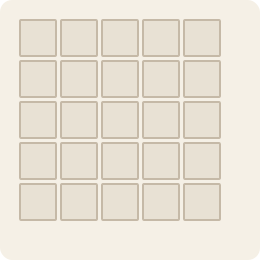
A 5 by 5 board with every tile closed
Start All positions are closed.
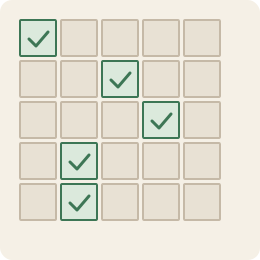
A 5 by 5 board with several safe tiles revealed
Safe reveals Fewer safe and unopened tiles remain.
A 5 by 5 board showing an opened mine
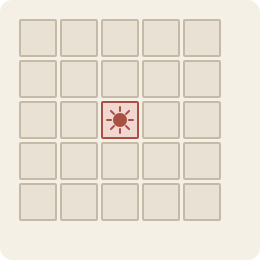
Mine revealed The illustrative round ends.

From desktop puzzle to modern game format

A short history of Mines

The Mines format belongs to a family of hidden-cell puzzle games made familiar by desktop Minesweeper in the 1990s. The central idea is simple: reveal a grid while avoiding hidden mines.

Modern Mines interfaces often simplify that idea into a compact board, a selected mine count and a sequence of reveals. The familiar grid makes the rules quick to learn, while the changing number of safe cells gives the format a clear probability layer.

Start with the four-step game model, then use the probability calculator to see how a board changes after safe reveals.

India context

Why the Mines format is popular in India

The format is easy to understand in a short mobile session: one clear board, a small number of controls and visible outcomes. Interest can also come from the recognisable grid-puzzle mechanic and from users looking to understand probability in plain language.

Quick to learn

The board makes the main rule visible immediately: find safe tiles and avoid a mine. Read the Mines game rules for each term.

Mobile-friendly model

A 5x5 board fits a focused mobile layout without complex menus or a long setup flow.

Probability is not a pattern

Understanding risk in Mines

Every unopened position may look identical. The chance of a safe next tile depends on the mine count and the number of already revealed safe tiles, but it does not reveal where a mine is located.

Past selections do not make the next location predictable. The probability calculator can show the proportion of remaining safe tiles; it cannot tell you which tile is safe.

There is no guaranteed pattern

Do not treat outcomes, sequences or visual layouts as signals for future random selections.

Useful tool

Check your Mines probability

Adjust mine count and already revealed safe tiles to see the mathematical chance of the next safe selection on a 5x5 board.

Open probability calculator

Mines Game FAQ

What is the Mines game?

Mines is a grid game model with hidden safe tiles and mines. A player reveals tiles while attempting to avoid a mine. This guide uses a 5x5 example board to explain the rules and the probability behind the remaining tiles.

How do you play Mines on a 5x5 board?

First choose the number of mines on the 25-tile board. Every tile starts closed. A selected safe tile reduces the number of safe and unopened positions. Revealing a mine ends the illustrative round.

What are the basic Mines game rules?

The board contains a fixed number of mines and safe tiles. A tile is revealed at a time. Safe tiles can form a sequence; a mine ends it. Exact screens and rules may differ between products.

What is a safe tile in Mines?

A safe tile is a position that does not contain a mine. On a 5x5 board with M mines, there are 25 minus M safe tiles before any tile is opened.

What happens when you reveal a mine?

In the basic Mines model, revealing a mine ends the round. This is why the chance of a safe selection is useful for describing risk, even though it cannot predict an individual tile.

Is Mines the same as Minesweeper?

Both use hidden mines and safe spaces, but their rules and interfaces can differ. Minesweeper commonly uses number clues, while a Mines game model may focus on a sequence of reveals and a selected mine count.

Are Mines game rounds random?

This guide assumes random mine placement. Random placement means the past sequence does not identify a guaranteed safe location. Always check the specific rules of the product you are viewing.

How can I calculate the chance of a safe tile?

Divide the number of remaining safe tiles by the number of unopened tiles. The probability calculator applies that formula to a 5x5 board and also shows chances for a selected series of future tiles.